

Driver Distraction Alerts
TensorGo Software Partners with Intel to Optimize its Advanced Driver Attention Metrics System

TensorGo’s Adam Solution Actively Focuses Distracted Drivers
Driver distraction is a major source of motor-vehicle accidents all over the world. From texting while driving to fiddling with navigation, driver distraction results in nine fatalities every day.1 In 2020 alone, the most recent year for which data is available, 3,142 people tragically died in collisions attributed to distracted driving.1
For ride-hailing companies like Uber and Lyft, as well as fleet management companies responsible for delivering goods, the risk of company drivers being involved in an accident is a constant concern, one that can become a major liability. Companies reliant on their employees following safe driving practices seek solutions that give them visibility into their employees’ driving behaviors with tools to directly help their drivers improve their safety practices.
TensorGo Software created the Advanced Driver Attention Metrics System, or Adams, to address the pressing need for improved driver safety in the transportation industry. Adams is a computer vision-based product that instantly notifies drivers when they exhibit signs of distraction, so they can take corrective action to protect themselves and those around them every time they drive.
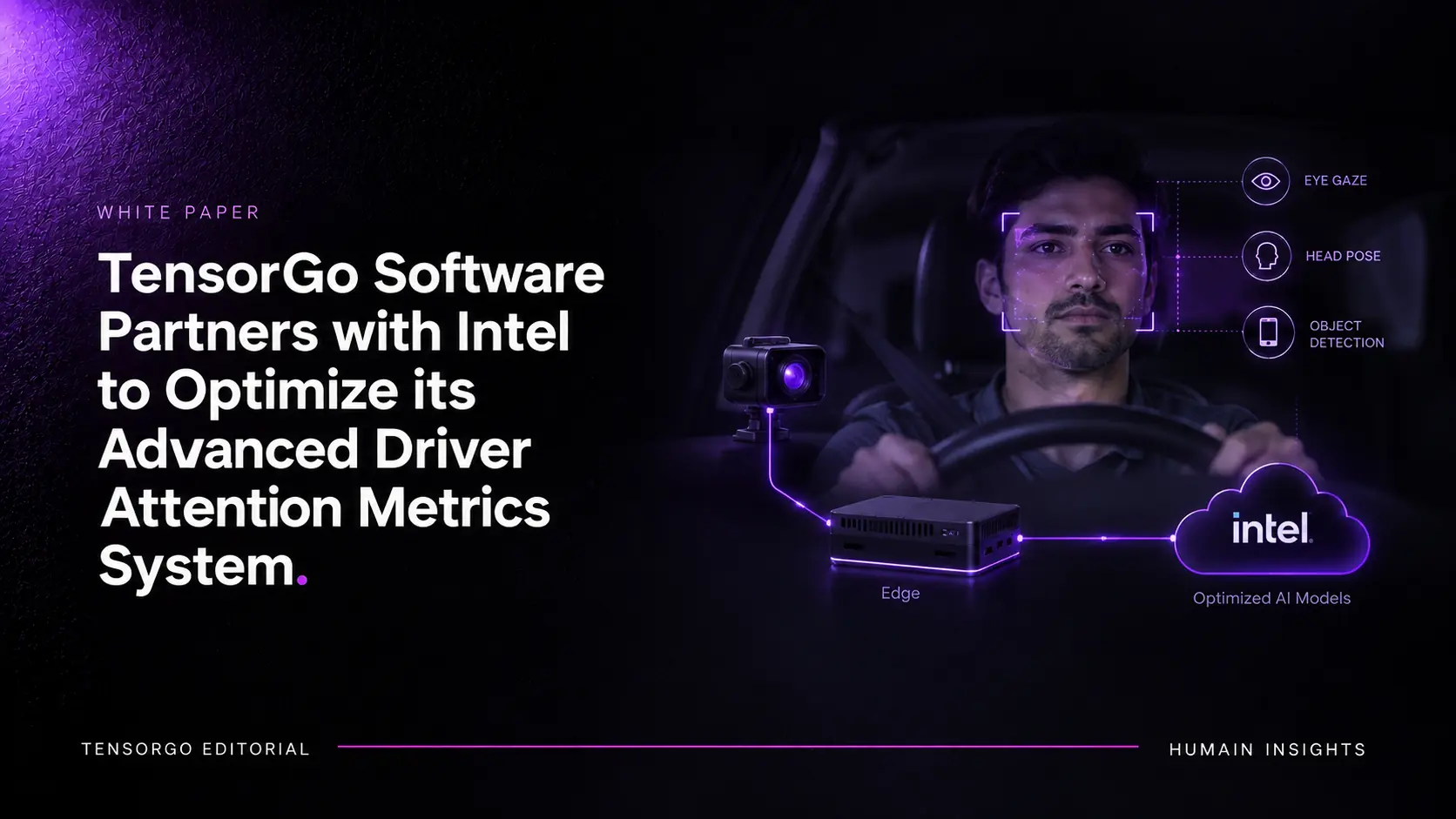
The solution leverages AI algorithms for eye gaze, head pose, and object detection to identify distracted driving cues, including drowsiness and dangerous diversions like cell phone usage. Adams connects to the driver's mobile device via Wi-Fi, enabling it to deliver auditory alerts to the driver in under a subsecond.2 Additionally, the Adams edge device sends this alert to a cloud database to notify fleet managers or anyone overseeing the operation. With this data, fleet managers can ensure that their drivers are safely driving company-registered vehicles, and in turn, enforce high delivery quality and reduce the company’s liability for potential accidents.
 1
How it Works
TensorGo Software designed Adams to be cost-effective, simple to install in any vehicle, and ready to use. The solution consists of a portable edge device that’s installed on the vehicle dashboard. A small camera is positioned on or near the steering wheel to face the driver and monitor cues of distraction.
Although Adams is compatible with various edge devices and cameras, Rasberry Pi edge devices and cameras are an ideal choice for deploying this solution at the edge. The Raspberry Pi camera is a small, high-quality camera that is positioned to clearly see the driver and is plugged into a Raspberry Pi edge device to process the data in real time. The metadata is emitted from Raspberry Pi to the cloud.
To ensure that Adams offers accurate detection of driver distractions to help prevent and reduce the severity of accidents, TensorGo created sophisticated AI algorithms to understand diverse driver behaviors and anomalies to make sure the driver is driving safely. The solution contains three AI algorithms embedded in the Rasberry Pi edge device.
Adams’ Advanced Facial Processing and Object Detection Algorithms
In addition to these three AI models, Adams can also be configured to detect:




Throughput is critical to run these AI-based capabilities in parallel while offering the driver real-time metrics for their driving.
 2
TensorGo Leverages the Capabilities of Intel® Technology to Enhance Adams at the Edge
Because of the complexities of Adams’ multiple AI models, it was initially difficult for TensorGo Software’s team to embed these algorithms within a small edge device with minimal Internet connectivity and power constraints. Even processing a single algorithm on such a compact device can be difficult, and in this case, TensorGo Software needed to process three computer vision AI algorithms on Raspberry Pi, a 32-bit processor.
TensorGo Software partnered with Intel architects to overcome these hardware constraints and optimize the AI algorithms using the Intel® Distribution of OpenVINO™ Toolkit to gain optimal performance at the edge via Rasberry Pi.
Meeting Edge Hardware Constraints with the Intel® Distribution of OpenVINO™ Toolkit
Initially, Adam’s modules were deployed on a bulkier edge device, which featured a 64-bit processor that was only compatible with same-brand edge devices and offered little flexibility. While the device was a miniature system designed to run AI workloads at the edge, it demanded intricate setup requirements, high power consumption, and ultimately was too inefficient to run Adams.
To enhance the power efficiency of Adams, TensorGo Software’s team transitioned to more optimized edge devices like Rasberry Pi. However, this shift presented a few challenges, primarily the need to transfer Adam’s AI algorithms from the larger 64-bit edge device to Rasberry Pi, a 32-bit edge device.
TensorGo Software worked with Intel Architects to successfully deploy Adams’ models with the Intel® Distribution of OpenVINO™ on top of the Raspberry Pi processor. First, they leveraged the toolkit to recode and optimize Adam’s algorithms to gain powerful CPU acceleration. These optimizations enabled TensorGo Software to achieve exceptional performance on the compact 32-bit Rasberry Pi CPU-orientated processor.
Additionally, these optimizations made it possible for Adam’s multiple AI models to run in parallel, offering real-time frame-by-frame detection at a rapid 25 frames per second (FPS). This frame rate surpasses the requirements of Adam’s detection capabilities to detect anomalies in real time.
Enhancing the Power Source of the Rasberry Pi Edge Device
Power supply emerged as another critical consideration. While Raspberry Pi could operate when powered through a USB connection, it failed to deliver the desired performance. In summary, the processor couldn’t draw the necessary energy from the USB power source of a vehicle.
Intel assisted TensorGo in identifying the solution: the provision of a direct 5-volt power supply to Rasberry Pi. This adjustment made a significant improvement to Rasberry Pi’s performance and ensured it received the necessary power without burdening the vehicle’s power system.
Disposing of Edge Device Heat
The other challenge of transitioning to a small Rasberry Pi edge device was that the heat generation of the device was depleting the performance of Adams as its temperature rose. Collaborating with Intel architects, TensorGo’s team explored solutions to mitigate this issue.
Intel provided the recommendation to not process all the frames within a second since a typical camera generates approximately 25 to 30 frames per second (FPS). Instead, Intel proposed that Adams process alternate frames or, if necessary, every fifth frame to optimize performance and ensure the algorithms are running consistently over extended periods of time.
TensorGo’s team adapted the solution to process every fifth frame, which effectively prevented overheating while maintaining processing speed. Despite not processing each frame, the performance remained unaffected. As a result, Adams’ algorithms remained accurate while not causing the edge device to overheat or slow down.
3Conclusion
Adams provides real-time driver attention metrics to drivers to alert them when they are distracted so they can take corrective action. Each of these distraction alerts is enabled by sophisticated video analytics monitoring the driver’s cues. To capture the broad spectrum of driver distraction at the edge, TensorGo Software partnered with Intel to optimize their AI models and overcome the hardware limitations of edge devices.
The partnership between TensorGo and Intel has resulted in a solution that offers smaller form factor and lower power consumption, while maintaining high performance at an affordable price. Through their partnership with Intel, TensorGo has reduced the computational requirements of Adams, freeing up resources to expand its capabilities and incorporate more AI models onto the compact device. For instance, this optimized AI workload is paving the way for Adams to:
- Emit alerts directly from the edge device itself rather than the driver’s phone with an additional global system for mobile communications (GSM) module
- Identify road anomalies that could cause a collision with an AI model monitoring the road
With Intel’s support, TensorGo Software has the toolset needed to not only enhance their solution’s application performance today, but also ensure it remains competitive well into the future.
Learn More
Sources
1Forbes ADVISOR: Distracted Driving Statistics & Facts In 2023. February 2023. Distracted Driving Statistics & Facts In 2023 – Forbes Advisor
2Internal Data of TensorGo Software.
Intel does not control or audit third-party data. Please review this content, consult other sources, and confirm that the data mentioned is accurate.
Notices & Disclaimers
Intel is committed to respecting human rights and avoiding complicity in human rights abuses.
See Intel’s Global Human Rights Principles. Intel® products and software are intended only to be used in applications that do not cause or contribute to a violation of an internationally recognized human right.
Intel technologies may require enabled hardware, software or service activation. No product or component can be absolutely secure. Your costs and results may vary. Intel does not control or audit third-party data. You should consult other sources to evaluate accuracy. Code names are used by Intel to identify products, technologies, or services that are in development and not publicly available. These are not "commercial" names and not intended to function as trademarks.
You may not use or facilitate the use of this document in connection with any infringement or other legal analysis concerning Intel products described herein. You agree to grant Intel a non-exclusive, royalty-free license to any patent claim thereafter drafted which includes subject matter disclosed herein.
© Intel Corporation. Intel, the Intel logo, and other Intel marks are trademarks of Intel Corporation or its subsidiaries. Other names and brands may be claimed as the property of others.
4